FTMO Prop Firm Review: Rules, Costs, and Payout Structure
Compare FTMO CFD challenges and Futures plans, including evaluation rules, drawdown differences, platform options, fees to check, and payout structures.
FTMO offers two CFD evaluation paths—a 1-Step Challenge and a 2-Step Challenge—plus a separate Futures product with Growth and Pro plans. The key structural difference is that the 1-Step has tighter loss limits (3% daily, 10% trailing max loss) but only one phase to pass, while the 2-Step uses a 5% daily loss limit and a static 10% max loss across two phases. This review covers every major rule, cost, and payout detail drawn directly from FTMO’s published documentation at ftmo.com. All accounts are simulated demo accounts with fictitious funds; any trading is in a simulated environment only.
Account Types: 1-Step, 2-Step, Swing, and Futures
FTMO’s CFD side has two evaluation products and two account types that can be applied to them. The FTMO Challenge: 1-Step is a single-phase evaluation; pass it and you move directly to an FTMO Account without a Verification phase. The FTMO Challenge: 2-Step runs a two-phase process: Phase 1 (FTMO Challenge) followed by Phase 2 (Verification), each with its own profit target. Source: ftmo.com/en/trading-objectives/
Within the CFD product, traders choose between two account types:
- Standard — subject to news-trading restrictions and overnight/weekend position restrictions once on the funded FTMO Account (not during evaluation). Available for both 1-Step and 2-Step.
- Swing — no restrictions on news trading or holding positions overnight or over the weekend. Available for the 2-Step only; the Swing account type is not offered for the 1-Step Challenge. Source: ftmo.com/en/faq/
The Futures product is a separate offering with its own evaluation structure, rules, and payout mechanics. It is not a variant of the CFD challenge. See the Futures section below for details. Source: ftmo.com/en/futures/
FTMO states it has served traders in 140+ countries and reports $650M+ paid in rewards since 2015. These are self-reported figures attributed to the firm; they are not independently verified here. Source: ftmo.com/en/
Trading Platforms Supported

For CFD accounts, FTMO supports four platforms: MetaTrader 4 (MT4), MetaTrader 5 (MT5), cTrader, and TradingView. TradingView integration is executed via the OANDA Broker Profile. Login credentials for all platforms are available in the Client Area. Source: ftmo.com/en/trading-platforms/
- MT5 — includes Depth of Market, six pending order types, and a multi-threaded Strategy Tester. Available on Windows, Android, MacOS, iOS.
- MT4 — widely used retail platform with real-time price feeds and order management. Available on iOS, Android, Windows, MacOS, and Web Browser.
- cTrader — supports C# and Python automation via cTrader Automate and an Open API. Available on iOS, MacOS, Android, Windows, and Web Browser.
- TradingView — web-based charting with Pine Script support. Available on Web Browser, Windows, MacOS, iOS, Android, and Linux.
Platform modification is permitted provided no trade has been placed on the current account. For FTMO Accounts, modification can be processed after each reward withdrawal. Source: ftmo.com/en/faq/
If platform choice matters to your workflow, see our guide on trading platforms for prop firms and our roundup of prop firms that connect to TradingView.
Evaluation Stages and Trading Objectives
The rules differ meaningfully between the 1-Step and 2-Step products. The table below summarises the key objectives for each phase. All figures are drawn from FTMO’s Trading Objectives page using a $100,000 account as the reference size. Source: ftmo.com/en/trading-objectives/
| Rule | 1-Step Challenge | 1-Step FTMO Account | 2-Step Phase 1 (Challenge) | 2-Step Phase 2 (Verification) | 2-Step FTMO Account |
|---|---|---|---|---|---|
| Profit Target | 10% ($10,000) | None | 10% ($10,000) | 5% ($5,000) | None |
| Max Daily Loss | 3% of initial capital (recalculated daily from midnight balance) | 3% (same rule applies) | 5% of initial capital (recalculated daily from midnight balance) | 5% (same rule) | 5% (same rule) |
| Max Loss (overall) | 10% trailing EOD (highest balance basis) | 10% trailing EOD; resets after reward withdrawal | 10% static (fixed at 90% of initial capital) | 10% static | 10% static |
| Min Trading Days | Not specified in source | N/A | 4 trading days | 4 trading days | None |
| Best Day / Consistency Rule | Best Day ≤ 50% of Positive Days’ Profit (sum of profitable days only) | Best Day ≤ 50% of Positive Days’ Profit (required for reward eligibility) | None stated in source | None stated in source | None |
How the Max Daily Loss is Calculated
For the 1-Step, the Maximum Daily Loss Limit is recalculated at 00:00 CE(S)T each day as: balance at midnight minus 3% of the initial simulated capital. On Day 1 of a $100,000 account, the limit is $97,000. If the balance rises to $102,000 by the next midnight, Day 2’s limit becomes $99,000. Equity (balance plus open P&L, swaps, and commissions) cannot drop below this limit at any point during the day. Source: ftmo.com/en/trading-objectives/
For the 2-Step, the same mechanism applies but the daily loss amount is 5% of initial capital, giving a Day 1 limit of $95,000 on a $100,000 account.
How the Max Loss (Overall) Differs Between Products
This is the most structurally important difference between the two CFD paths. On the 1-Step, the overall Max Loss is an end-of-day trailing limit: it is calculated from the highest closing balance ever recorded, so it can only move upward as you profit. On the 2-Step, the Max Loss is static: it is fixed at 90% of the initial capital from day one and never changes regardless of profits. A $100,000 2-Step account always has a hard floor of $90,000. Source: ftmo.com/en/trading-objectives/
The Best Day Rule (1-Step Only)
The 1-Step Challenge and 1-Step FTMO Account both carry a Best Day Rule: your single most profitable day must not exceed 50% of the sum of all profitable days’ closed profit. Breaching the threshold is not an immediate disqualification — you must continue trading until the ratio falls to 50% or below. This rule applies during both the challenge phase and on the funded account (where it gates reward eligibility). The 2-Step does not carry this rule. Source: ftmo.com/en/trading-objectives/
For a broader explanation of how consistency rules work across firms, see our guide on prop firms with no consistency rule.
Challenge Fees and Refund Policy
FTMO charges a one-time fee to enter a Challenge. The FAQ confirms there is a fee, and the firm’s FAQ page lists “Is the entry fee refunded?” as a question — however, the full answer text is not detailed on the overview page in the provided source excerpts. The sources confirm the fee exists and that it is a one-time entry cost, not a recurring subscription for CFD challenges. Source: ftmo.com/en/faq/
Important: The exact fee amounts per account size are not confirmed in the documentation reviewed. FTMO’s pricing page (not fetched) would contain current figures. Do not rely on third-party summaries for current prices; verify directly at ftmo.com before purchasing. The sources do confirm a 20% promotional discount was active on the $100K 1-Step Challenge CFD at the time of fetching. Source: ftmo.com/en/
For the Futures product, the evaluation runs on a monthly subscription model (not a one-time fee). The Futures FAQ confirms “each account runs on its own monthly subscription.” There is no activation fee stated for Futures. Source: ftmo.com/en/futures/
News Trading, Overnight Holding, and Weekend Positions
These restrictions depend entirely on which account type you choose, and they apply differently during evaluation versus the funded stage.
- During evaluation (both 1-Step and 2-Step): No restrictions apply regardless of account type. You may trade news and hold positions overnight or over the weekend freely during the evaluation process. Source: ftmo.com/en/faq/
- Standard account type on the FTMO Account (funded stage): News trading restrictions apply during selected news releases. Overnight and weekend position holding is also restricted. Source: ftmo.com/en/faq/
- Swing account type on the FTMO Account: No restrictions on news trading or holding positions overnight or over the weekend. Source: ftmo.com/en/faq/
- Swing account availability: The Swing type is only available for the 2-Step. It cannot be selected for the 1-Step Challenge. Source: ftmo.com/en/faq/
Traders who rely on holding positions through weekends or trading around high-impact news events should choose the 2-Step path with the Swing account type. Choosing the 1-Step locks you into the Standard account type, which carries funded-stage restrictions on both news and overnight/weekend holding.
Profit Split, Rewards, and Scaling
FTMO uses the term “rewards” rather than profit split, consistent with the simulated account structure. The homepage states $650M+ paid in rewards since 2015 — this is a self-reported firm figure. Source: ftmo.com/en/
The specific reward percentage split for CFD accounts is not stated in the documentation reviewed. FTMO’s site references a scaling plan and a Premium Programme (see below), both of which affect reward access and account size. Verify the current split percentage directly at ftmo.com.
For the Futures product, the payout ratio is stated as 90% on the overview page. Source: ftmo.com/en/futures/
On the Futures Sim-Funded Account, payouts can be requested once conditions on the Trading Objectives and Rules page are met. Upon confirming a withdrawal request in the Client Area, all open positions and pending orders are closed, and a calculator displays the available payout. Source: ftmo.com/en/futures/
For CFD accounts, the reward withdrawal process triggers a reset of the Maximum Loss Limit on 1-Step accounts: after each reward withdrawal, a new FTMO Account is provided and the Max Loss Limit resets to 90% of the new initial simulated capital. Source: ftmo.com/en/trading-objectives/
See our broader guide on prop firm payout rules for context on how withdrawal mechanics vary across firms.
The Premium Programme: Prime and Supreme Status
FTMO operates a Premium Programme with two tiers: Prime Status and Supreme Status. The FAQ lists qualification criteria and benefits for each tier, and notes that the Premium Programme is compatible with the Scaling Plan. The programme is described as providing “exclusive benefits” and is linked to Quantlane by FTMO. Source: ftmo.com/en/
The specific qualification thresholds (account sizes, performance metrics) and the exact benefits of each tier are not fully reproduced in the documentation reviewed. The FAQ page confirms the questions exist: “How do I qualify for Prime Status?”, “What are the benefits of Prime Status?”, “How do I qualify for Supreme Status?”, and “Once I’m in the Premium Programme, do I keep it permanently?” — but the full answer text is not detailed on the overview page. Source: ftmo.com/en/faq/
Traders interested in the Premium Programme should review the dedicated section at ftmo.com directly, as the qualification rules and benefit details require the full operative terms to evaluate accurately.
CFD Accounts vs Futures Accounts: Key Differences
FTMO’s CFD and Futures products are structurally distinct. The table below summarises the main differences based on the linked documentation.
| Feature | CFD (1-Step or 2-Step) | Futures (Growth or Pro) |
|---|---|---|
| Evaluation phases | 1 phase (1-Step) or 2 phases (2-Step) | 1 phase (Evaluation), then Sim-Funded Account |
| Fee model | One-time challenge fee | Monthly subscription per account |
| Payout ratio | Not confirmed in linked documentation | 90% stated by FTMO |
| Payout frequency | Not confirmed in linked documentation | Growth plan: every 4 days |
| Consistency rule | Best Day ≤ 50% of Positive Days’ Profit — sum of profitable days only (1-Step only) | Growth Evaluation: Best Day ≤ 40% of total profit (cumulative sum of all days’ closed P&L); Pro Evaluation: Best Day ≤ 50% of total profit (same denominator); no consistency rule on Sim-Funded |
| Daily loss limit | 3% (1-Step) or 5% (2-Step) of initial capital | Growth: none during Evaluation; Pro: hard daily loss limit applies |
| Max drawdown type | Trailing EOD (1-Step) or static (2-Step) | EOD trailing for both Growth and Pro Evaluations |
| News trading | Restricted on Standard funded account; unrestricted on Swing | Allowed (stated on Futures overview) |
| Max Sim-Funded accounts | Not specified in linked documentation | Up to 3 Sim-Funded accounts simultaneously |
| Max simulated capital | Up to $200,000 (stated on homepage) | Up to $450,000 across Sim-Funded accounts |
| Live account path | Not described in linked documentation | Top performers considered for a Live Account |
Source: ftmo.com/en/futures/ | Source: ftmo.com/en/futures/trading-objectives-and-rules/
Futures Evaluation Rules in Detail
The Futures product has two plan variants — Growth and Pro — each available at $50K, $100K, and $150K account sizes. A trading day for Futures purposes runs from 6:00 p.m. ET to 4:10 p.m. ET the following calendar day. Source: ftmo.com/en/futures/trading-objectives-and-rules/
Profit targets during Evaluation:
- $50K account: $3,000 profit target
- $100K account: $6,000 profit target
- $150K account: $9,000 profit target
Max Drawdown (EOD Trailing) during Evaluation:
- Growth $50K: $2,000 | Growth $100K: $3,500 | Growth $150K: $5,000
- Pro $50K: $3,000 | Pro $100K: $4,500 | Pro $150K: $6,000
The drawdown limit trails upward from the highest closing balance but locks permanently at the initial simulated capital once it reaches that level. After locking, it remains fixed unless a Reset Fee is paid or the limit is breached. Source: ftmo.com/en/futures/trading-objectives-and-rules/
Daily Loss Limit during Evaluation:
- Growth plans: No daily loss limit during Evaluation.
- Pro $50K: $1,000 | Pro $100K: $1,500 | Pro $150K: $2,000. This is a hard limit; breaching it ends the Evaluation.
Consistency Rule during Evaluation:
- Growth plans: Best Day must not exceed 40% of total profit to pass.
- Pro plans: Best Day must not exceed 50% of total profit to pass.
- On the Sim-Funded Account: no consistency rule applies. Source: ftmo.com/en/futures/
Exceeding the consistency threshold is not an immediate breach in either case — you must continue trading until the ratio falls within the limit. Source: ftmo.com/en/futures/trading-objectives-and-rules/
For traders comparing futures prop firms, see our futures prop firms overview and the My Funded Futures review for an alternative structure.
Who FTMO Suits and Who It Does Not
Based on the rules documented above, here is a grounded assessment of fit by trading style:
- Day traders and scalpers (CFD): The 2-Step Standard account is workable. The 5% daily loss limit gives more intraday room than the 1-Step’s 3%. No overnight holding required.
- Swing traders (CFD): Must use the 2-Step with the Swing account type to avoid overnight/weekend restrictions on the funded account. The 1-Step does not offer Swing.
- News traders (CFD): Restrictions apply only on Standard funded accounts, not during evaluation. Swing account type removes news restrictions entirely on the funded stage.
- Algorithmic and systematic traders: MT5 and cTrader both support automation. cTrader Automate supports C# and Python; MT5 has a multi-threaded Strategy Tester.
- Futures traders: The Growth plan has no daily loss limit during evaluation and a softer drawdown, making it more accessible. The Pro plan allows 100% profit withdrawal with higher payout caps but adds a hard daily loss limit. News trading is allowed on Futures.
- Traders who need maximum flexibility: The 1-Step’s Best Day Rule (50% cap) and tighter 3% daily loss limit make it less forgiving for traders with uneven daily P&L distributions. The 2-Step’s static drawdown is simpler to track but offers no trailing benefit.
FTMO is not suitable for traders who want to hold positions overnight or over the weekend on a Standard CFD funded account, or for those whose strategy depends on concentrating gains in single large trading days (given the Best Day Rule on the 1-Step).
For comparison with other established firms, see our FundedNext review and the full prop firm reviews index. For a broader look at challenge structures, see prop firm challenge types.
Statistical Application and Market Analysis
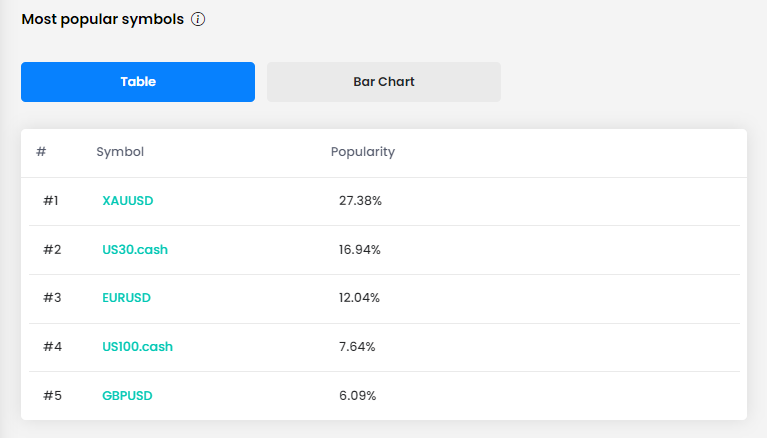
FTMO’s Statistical Application lesson explains its Market Analysis and Symbol Analysis views. The first groups market statistics such as symbol popularity; the second examines individual instruments. These are research tools, not signals that guarantee a profitable trade.
The older official lesson screenshot below illustrates the interface and its symbol-popularity table. Its displayed percentages are historical examples, not current market readings. Use it to understand the layout rather than to choose a trade or infer current account rules.