Topstep Buffer Rule Explained: What It Is and How to Stay Compliant
Understand Topstep payout buffers and loss-limit considerations, and check the current requirements for your specific account stage.
The Topstep buffer rule is a funded-account protection mechanism that prevents traders from placing new trades when their real-time account equity drops too close to the trailing maximum drawdown threshold. In practical terms, it means you cannot simply trade down to the exact drawdown floor — there is a defined equity buffer above that floor that must remain intact for trading to continue. Understanding where that buffer sits, how it is calculated in real time, and what actions can accidentally consume it is essential before you place a single live trade on a Topstep funded account.
This page explains the rule in plain language, walks through common ways traders unknowingly break it, and outlines exactly what you should verify inside your Topstep dashboard and rulebook before you trade. For a broader look at how funded-account rules compare across firms, visit the PropCatalog rules hub.
What the Topstep Buffer Rule Actually Means
Topstep funded accounts operate under a trailing drawdown model during the evaluation phase and, depending on the account type, a fixed or trailing drawdown model once funded. The buffer rule is a layer on top of that drawdown structure. Rather than allowing you to trade all the way to the drawdown floor, Topstep requires that your account equity remain above a specified buffer level at all times — including intraday, while positions are open.
The key distinction is that the buffer is measured against your real-time account balance, not just your end-of-day balance. If an open position moves against you and your floating equity touches or breaches the buffer threshold, the rule is triggered regardless of whether you have closed the trade. This is not a rule that resets at the end of the session — it is active every second a position is live.
Because Topstep’s specific buffer thresholds, account sizes, and exact dollar figures are subject to change, you must verify the current values directly on Topstep’s official rules page or inside your funded-account dashboard before trading. Do not rely on third-party summaries, including this one, for the exact numbers. Use this page to understand the structure and logic of the rule, then confirm the live figures at the source.
How the Buffer Rule Works in Practice
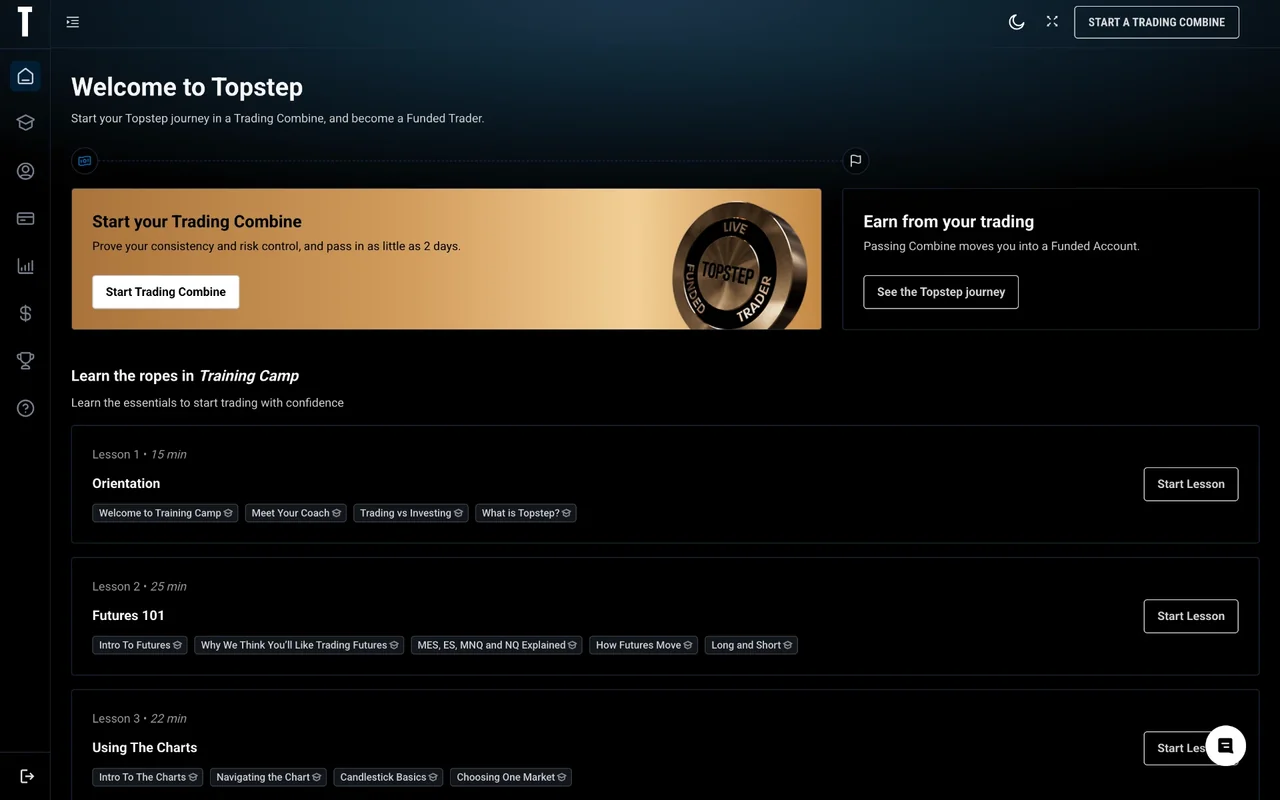
To understand the buffer rule mechanically, it helps to think of your account as having three equity levels that matter:
- Starting balance — the account value at the beginning of the funded period or evaluation.
- Trailing drawdown floor — the lowest your account equity is permitted to reach, which may trail upward as your balance grows (during evaluation) or remain fixed (in some funded phases).
- Buffer threshold — the equity level above the drawdown floor that you must maintain at all times while trading.
The buffer threshold is the critical number. If your account equity — including unrealized losses on open positions — falls to or below the buffer threshold, you are in violation of the rule. Depending on Topstep’s current policy, this may result in an automatic position liquidation, an account breach, or both.
Here is a simplified educational scenario to illustrate the structure (figures are illustrative only — verify actual thresholds with Topstep):
| Account Metric | Illustrative Example | What It Means |
|---|---|---|
| Starting balance | $150,000 | The funded account opening value |
| Trailing drawdown floor | $148,500 | The absolute minimum equity permitted |
| Buffer threshold | $149,000 | The level you must stay above while trading |
| Tradeable equity zone | Above $149,000 | The only zone where new positions are permitted |
In this scenario, even though the drawdown floor is $148,500, you cannot trade once your equity reaches $149,000. The $500 gap between the buffer and the floor is the protected zone. You do not get to use that space — it exists as a structural safeguard.
Verify the exact dollar amounts and buffer structure for your specific account size on Topstep’s official platform or help center before you trade.
What Can Accidentally Break the Buffer Rule
Most buffer rule violations are not caused by reckless trading. They are caused by traders who understand the drawdown floor but forget — or never knew — that the buffer sits above it. These are the most common accidental triggers:
Holding positions into adverse overnight or pre-market moves
If Topstep’s rules permit overnight holding on your account type, a gap open against your position can move your floating equity below the buffer threshold before you have a chance to react. The rule does not pause for market hours — it applies to your real-time equity at all times.
Scaling into a losing position
Adding contracts to a position that is already moving against you accelerates the rate at which your floating equity approaches the buffer. Traders who average down without accounting for the buffer threshold are among the most common rule-breach cases.
Misreading the trailing drawdown direction
During the evaluation phase, Topstep’s trailing drawdown typically moves upward as your account grows. This means the buffer threshold also moves upward. A trader who locks in a profit, sees the drawdown floor rise, and then gives back gains may find the buffer threshold is now higher than they expected — leaving less room than they assumed.
Confusing end-of-day balance with real-time equity
Some traders check their balance at the end of a session, see they are comfortably above the buffer, and then trade the next session without accounting for open positions or commissions that reduce real-time equity. The buffer is measured on floating equity, not closed-trade balance.
Ignoring commissions and fees in the equity calculation
Commissions, platform fees, and data fees reduce your account balance. If these costs are deducted in real time, they contribute to equity erosion and can push you closer to the buffer threshold than your gross P&L suggests.
Rule Interpretation Box and Mistake Checklist
How to read the buffer rule: The buffer rule does not give you permission to trade down to the drawdown floor. It removes a portion of the space above the floor from your usable trading range. Your effective maximum loss per session or per trade must be calculated against the buffer threshold, not the drawdown floor. Any risk management plan that uses the drawdown floor as the stop point is already miscalibrated.
Common mistake checklist — verify each point before trading:
- ☐ I know the exact dollar value of my current buffer threshold (not just the drawdown floor).
- ☐ I have confirmed whether the buffer threshold trails upward with profits or remains fixed.
- ☐ I have confirmed whether the buffer applies to floating equity (open positions) or only closed equity.
- ☐ I have accounted for commissions and fees in my real-time equity estimate.
- ☐ I know whether my account type permits overnight holding and what gap-risk that creates relative to the buffer.
- ☐ I have checked the buffer threshold in my dashboard today, not from a cached or third-party source.
- ☐ I have set a personal stop level above the buffer threshold so I never approach it during live trading.
- ☐ I understand that adding contracts to a losing position accelerates equity erosion toward the buffer.
What to Verify in the Topstep Dashboard and Rulebook
Topstep provides account metrics inside its trading dashboard and publishes rules in its help center. Before trading, locate and confirm the following data points directly from those official sources:
| Data Point | Where to Find It | Why It Matters |
|---|---|---|
| Current buffer threshold value | Topstep funded-account dashboard | This is the number your equity must stay above |
| Whether the buffer trails or is fixed | Topstep rules page or help center | Determines whether the threshold moves as you profit |
| Real-time vs. end-of-day measurement | Topstep rules page | Confirms whether open positions count toward the threshold |
| Consequence of breaching the buffer | Topstep rules page or support | Tells you whether breach means liquidation, warning, or account closure |
| Fee deduction timing | Topstep billing or platform settings | Affects real-time equity calculation |
| Overnight holding permissions | Topstep rules page by account type | Determines gap-risk exposure relative to the buffer |
If any of these data points are unclear after reviewing the dashboard and help center, contact Topstep support directly and ask for written confirmation. Do not assume based on forum posts, YouTube videos, or third-party summaries.
Who This Rule Matters Most For
The buffer rule has the most practical impact on specific trading styles and account situations. It is not equally relevant to every trader on every day.
High-frequency intraday traders
Traders who open and close many positions per session accumulate commission costs quickly. Each round-trip reduces real-time equity by a small amount. Over many trades, this erosion can push equity meaningfully closer to the buffer threshold even on a flat P&L day.
Traders who scale position size
Adding contracts increases both potential profit and potential loss per tick. A trader running larger size has less room for adverse movement before the buffer threshold is reached. The buffer rule effectively caps the position size that is safe to run at any given equity level.
Traders near the end of a drawdown cycle
If your account has experienced losses and your equity is already closer to the drawdown floor than it was at the start, the buffer threshold is now a much more immediate constraint. Traders in this situation need to recalculate their effective risk room before placing any new trade.
Traders who hold positions overnight
If Topstep permits overnight holding on your account type, gap risk is real. A position that closes the session within the safe zone can open the next session below the buffer threshold if the market gaps against you. This is one of the highest-risk scenarios for an accidental buffer breach.
Related Rules to Check Before You Trade
The buffer rule does not exist in isolation. It interacts with several other Topstep rules that you should understand before trading. Verify each of these on Topstep’s official rules page:
- Trailing drawdown rule — defines the floor that the buffer sits above. You cannot understand the buffer without knowing exactly how the trailing drawdown is calculated and when it stops trailing.
- Daily loss limit — some Topstep account types include a separate maximum daily loss rule. This may trigger before the buffer threshold is reached, depending on the day’s starting equity.
- Position size limits — maximum contract limits per instrument affect how quickly your equity can move toward the buffer in a single adverse move.
- Consistency rule — if Topstep applies a consistency requirement to your account, your best trading days may be capped, which affects how much equity cushion you can build above the buffer.
- Overnight and weekend holding rules — these determine your gap-risk exposure and whether you can hold positions through periods when you cannot actively monitor equity.
For a broader comparison of how different prop firms structure their drawdown and buffer rules, see the PropCatalog compare hub. To understand how challenge structures affect which rules apply at which stage, visit the challenge types guide.
Example Scenarios: Buffer Rule in Action
The following scenarios are educational illustrations only. They use placeholder figures to demonstrate the rule’s logic. Do not use these figures as your actual thresholds — verify your real numbers in your Topstep dashboard.
Scenario A: Trader stays compliant
A trader opens a funded account with a starting balance of $100,000. The trailing drawdown floor is currently at $97,000 and the buffer threshold is at $97,500. The trader sets a personal hard stop at $98,000 — $500 above the buffer — and never lets a position run beyond that intraday loss. Even on a losing day, the trader closes positions before reaching the buffer threshold. The account remains active.
Scenario B: Trader breaches the buffer without realizing it
A trader has a starting balance of $100,000. After several profitable days, the trailing drawdown floor has moved up to $99,000 and the buffer threshold is now at $99,500. The trader, who last checked the dashboard two days ago, believes the floor is still at $97,000 and trades with that assumption. A position moves against them, and their floating equity drops to $99,200 — below the buffer threshold of $99,500. The rule is triggered. The trader did not intend to breach the rule; they simply failed to check the updated threshold after profits moved the trailing floor upward.
Scenario C: Commission erosion near the buffer
A trader ends a session with a closed-trade balance of $98,000. The buffer threshold is $97,800. The trader believes they have $200 of room. However, they have 10 open micro contracts with unrealized losses of $150, and the platform has not yet deducted $80 in commissions from the session. Their real-time equity is approximately $97,770 — below the buffer threshold. The trader did not account for the combination of floating losses and pending fee deductions.

Jade-Kyra Cronje
Jade-Kyra covers trading platforms, strategy-focused content, and crypto prop firm research for PropCatalog.
FAQs
Is the Topstep buffer rule the same as the trailing drawdown rule?
No. The trailing drawdown rule defines the absolute floor your equity cannot breach. The buffer rule sets a threshold above that floor that you must stay above while trading. They are related but distinct. The buffer effectively reduces the usable space between your current equity and the drawdown floor. Verify both thresholds separately in your Topstep dashboard and rulebook.
Does the buffer apply to floating equity or only closed trades?
Based on how Topstep’s drawdown structure is generally described, the threshold applies to real-time equity including open positions. This means an unrealized loss on an open trade counts toward the buffer calculation. Confirm this specifically for your account type on Topstep’s official rules page, as policies can vary by account tier or may be updated.
What happens if I breach the buffer threshold?
The consequence depends on Topstep’s current policy for your account type. Possible outcomes include automatic position liquidation, account suspension, or account closure. Do not assume the consequence is a warning — verify the exact outcome on Topstep’s rules page or by contacting their support team before you trade.
Does the buffer threshold change as my account grows?
During the evaluation phase, Topstep uses a trailing drawdown that moves upward as your balance increases. If the buffer is calculated relative to the trailing floor, it will also move upward as you profit. This is one of the most common sources of confusion — traders assume the buffer is fixed at the starting level when it may have already moved. Check your dashboard after every profitable session to see the current threshold.
Can I reset my account if I breach the buffer rule?
Topstep has historically offered reset options for evaluation accounts, but the availability, cost, and conditions of resets are subject to change. Verify the current reset policy directly on Topstep’s website or help center. For funded accounts, the reset policy may differ significantly from evaluation accounts. See the PropCatalog reviews section for context on how firms handle resets, and confirm specifics with Topstep directly.
How do I find my current buffer threshold in the Topstep dashboard?
Log into your Topstep account and navigate to the account metrics or performance section of the dashboard. Look for your trailing drawdown floor and any buffer or minimum equity figure displayed alongside it. If the dashboard does not clearly label the buffer threshold separately from the drawdown floor, contact Topstep support and ask them to confirm the exact equity level below which trading is not permitted. Do not trade until you have that number confirmed. For context on what to look for in funded-account dashboards generally, see the PropCatalog payouts guide.