Topstep Scaling Plan Micros: Lot Limits and Ratio Rules
How the Topstep Scaling Plan works for micro contracts in the XFA: the 10:1 ratio, lot limits by account size and balance tier, and special product exceptions.
According to Topstep, the Scaling Plan is an Express Funded Account (XFA) objective that sets your Maximum Position Size—the maximum contracts you can hold at one time—based on your current account balance. For micro contracts, a 10:1 ratio applies: 1 mini equals 10 micros, and all limits are expressed in mini-equivalent lots. Three micro products—Micro Silver (SIL), Micro Bitcoin (MBT), and Micro Ether (MET)—carry special weightings that deviate from the standard ratio, as documented in the Topstep Help Center.
What the Topstep Scaling Plan Is
According to Topstep, the Scaling Plan is an Express Funded Account (XFA) objective. It sets the Maximum Position Size—the maximum contracts a trader can hold at one time—based on the current account balance. As the account balance grows, so does the available buying power, expressed through tiered lot limits that increase at defined balance thresholds.
The Scaling Plan applies to both the Trading Combine and the Express Funded Account. It does not apply to the Live Funded Account, where Topstep states it has been replaced by Dynamic Live Risk Expansion. Traders are never required to trade their maximum allowed contracts; the Scaling Plan sets a ceiling, not a floor.
Topstep describes the Scaling Plan as a guide for responsibly leveraging a growing account, noting that over-leveraging causes the most damage to long-term success. For a broader look at how Topstep structures its accounts, see the Topstep review on PropCatalog and the Prop Firm Rules index for context on how similar position-size rules work across the industry. Source: Topstep Help Center – What is the Scaling Plan?
How Micro Contracts Are Counted (10:1 Ratio)
According to Topstep, micro contracts follow a 10:1 ratio: 1 mini equals 10 micro contracts. All position limits under the Scaling Plan are expressed in mini-contract equivalents, so a trader’s micro allowance is always 10 times the stated lot figure.
Topstep provides this documented example for a $50K XFA with a 2-lot Scaling Plan limit: a trader may hold 2 minis, 20 micros, or any combination equal to 2 minis. For instance, holding 1 mini and 10 micros would consume the full 2-lot allowance. Holding 1 mini and 9 micros would leave 1 micro of capacity remaining.
Topstep notes that the micro-to-mini ratio functionality is available for the Trading Combine and Express Funded Account. It is not currently available for the Live Funded Account. Traders on the Live Funded Account cannot use this conversion and should consult Topstep’s separate Live Funded Account documentation. For general context on how prop firm position rules are structured, see Prop Firm Rules Explained. Source: Topstep Help Center – What is the Scaling Plan?
Lot Limits by Account Size and Balance Tier
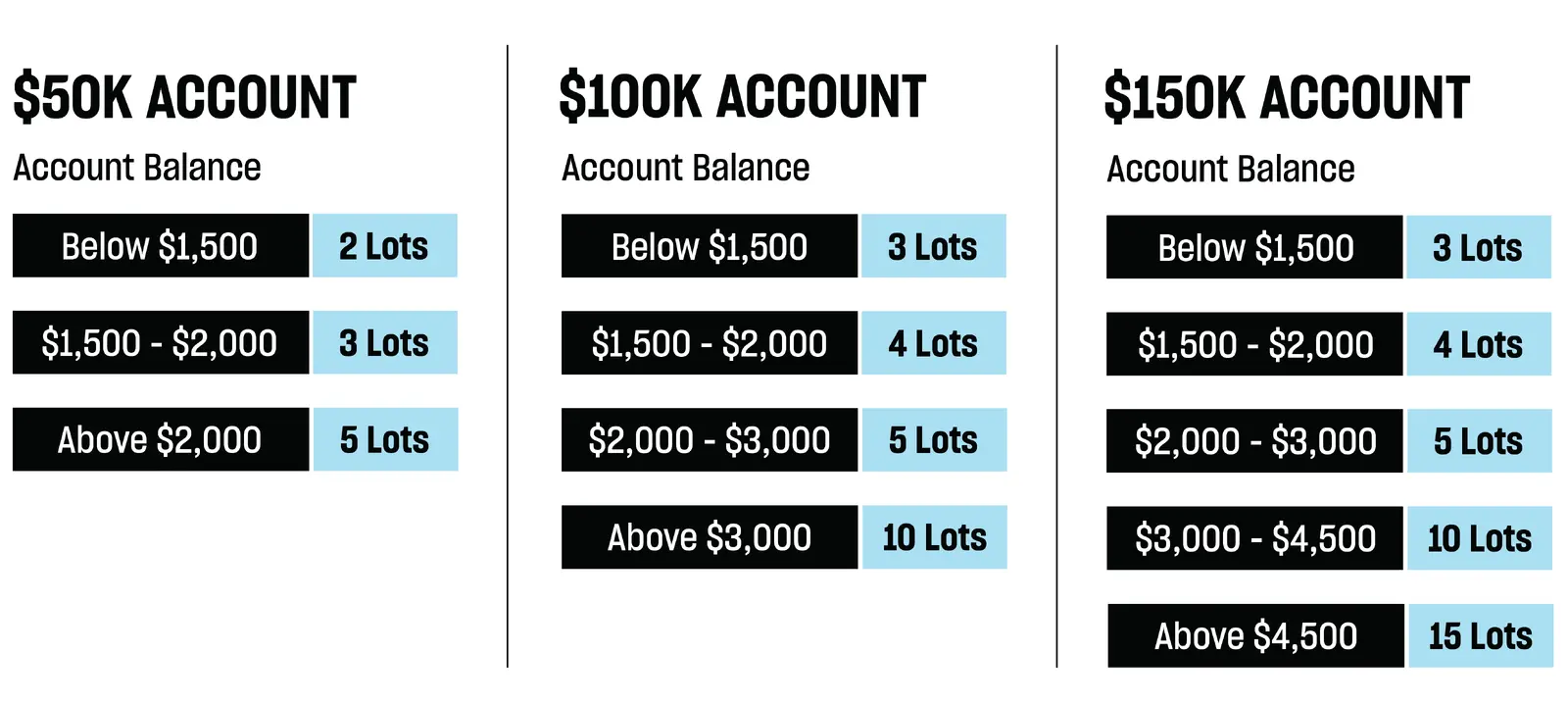
According to Topstep, lot limits vary by account size and increase in tiers as the account balance grows. The table below reflects the documented tiers for each XFA account size. Each lot figure is in mini-equivalent terms; micro limits are 10 times each figure under the standard 10:1 ratio.
| Account Size | Balance Tier | Max Lots (Mini-Equivalent) | Max Micros (10:1) |
|---|---|---|---|
| $50K XFA | Below $1,500 | 2 | 20 |
| $50K XFA | $1,500–$2,000 | 3 | 30 |
| $50K XFA | Above $2,000 | 5 | 50 |
| $100K XFA | Below $1,500 | 3 | 30 |
| $100K XFA | $1,500–$2,000 | 4 | 40 |
| $100K XFA | $2,000–$3,000 | 5 | 50 |
| $100K XFA | Above $3,000 | 10 | 100 |
| $150K XFA | Below $1,500 | 3 | 30 |
| $150K XFA | $1,500–$2,000 | 4 | 40 |
| $150K XFA | $2,000–$3,000 | 5 | 50 |
| $150K XFA | $3,000–$4,500 | 10 | 100 |
| $150K XFA | Above $4,500 | 15 | 150 |
Source: Topstep Help Center – What is the Scaling Plan?
Mid-Session Rule: When Limits Update
According to Topstep, maximum contracts do not increase mid-session. If a trader crosses a balance threshold during an active trading session, the higher lot limit does not take effect immediately. The trader must wait until the next session for the increased limit to become available.
This rule has a practical consequence worth understanding. Hypothetical example (clearly labelled): suppose a $50K XFA trader starts a session with a balance just below $1,500, giving them a 2-lot limit. During that session, profitable trades push the balance above $1,500. Despite crossing the $1,500 threshold, the trader remains capped at 2 lots for the remainder of that session. Only at the start of the following session does the 3-lot limit apply.
The inverse is also worth noting: Topstep’s documentation does not state that limits decrease mid-session if a balance falls back below a threshold, but traders should verify current platform behaviour via the TopstepX Risk Settings page, which shows contracts available for the next session. Staying aware of your session boundary is therefore a practical compliance step. Source: Topstep Help Center – What is the Scaling Plan?
Special Micro Product Weightings
According to Topstep, some micro products are weighted differently and do not follow the standard 10:1 ratio. Three products carry documented special rules.
Micro Silver (SIL) uses a 5:1 ratio versus Silver (SI) rather than the standard 10:1. Additionally, SIL counts as 2 of any other micro for position limit purposes. This means a trader with a 2-lot (20-micro) allowance could hold a maximum of 10 SIL contracts, not 20, because each SIL consumes 2 micro-equivalent slots.
Micro Bitcoin (MBT) and Micro Ether (MET) are each capped at mini-equivalent lot sizes rather than following standard micro scaling. Topstep’s documentation does not elaborate further on the precise conversion for MBT and MET beyond this cap, so traders holding these products should treat the mini-equivalent lot figure as their ceiling and confirm current limits on the TopstepX Risk Settings page.
These exceptions matter practically: a trader who assumes all micros behave identically under the 10:1 rule could inadvertently exceed their limit when trading SIL, MBT, or MET. Source: Topstep Help Center – What is the Scaling Plan?
Compliance: Errors, Overrides, and Tools
According to Topstep, if a trader accidentally exceeds their position limit but corrects it within 10 seconds, the error is ignored. Holding excess contracts for 10 or more seconds may result in an account review. Topstep’s guidance is direct: know your net exposure and correct it fast.
Topstep also states that during extreme volatility, it may temporarily tighten position limits on affected products, overriding the standard Scaling Plan tiers. This means the documented lot limits are not guaranteed to be the operative limits at all times; a product-specific tightening can apply without advance notice.
To reduce the risk of breaching the Scaling Plan, Topstep recommends three practical steps: set up your workspace to display open positions and orders at all times; enable Order Confirmation, which requires you to reconfirm before an order submits; and use the Contract Limits feature in the Risk Settings page to set a per-product maximum. Current contract limits for the next session are visible on the TopstepX Risk Settings page. For broader context on how prop firm rules interact with compliance tools, see Prop Firm Rules Explained and the Topstep Buffer Rule page. Source: Topstep Help Center – What is the Scaling Plan?
Scaling Plan as an XFA Objective
According to Topstep, following the Scaling Plan is a stated objective for both XFA payout paths—XFA Standard and XFA Consistency. In both cases, the rule is defined as: follow the Scaling Plan—the maximum contracts you can hold at one time—based on your current account balance.
For XFA Standard, the objectives include following the Scaling Plan, not hitting the Maximum Loss Limit, and achieving 5 winning days with at least $150 profit each. For XFA Consistency, the objectives include following the Scaling Plan, not hitting the Maximum Loss Limit, trading at least 3 days with at least 1 trade per day, and keeping the consistency ratio (Largest Winning Day ÷ Total Net Profit) at 40% or below.
Breaching the Scaling Plan is therefore not a minor procedural issue—it is a failure of a core XFA objective that can affect payout eligibility on either path. Traders who want to understand how the Scaling Plan interacts with the consistency objective should also review the Topstep Consistency Rule page. For a full account overview, see the Topstep review. Source: Topstep Help Center – Express Funded Account Parameters